
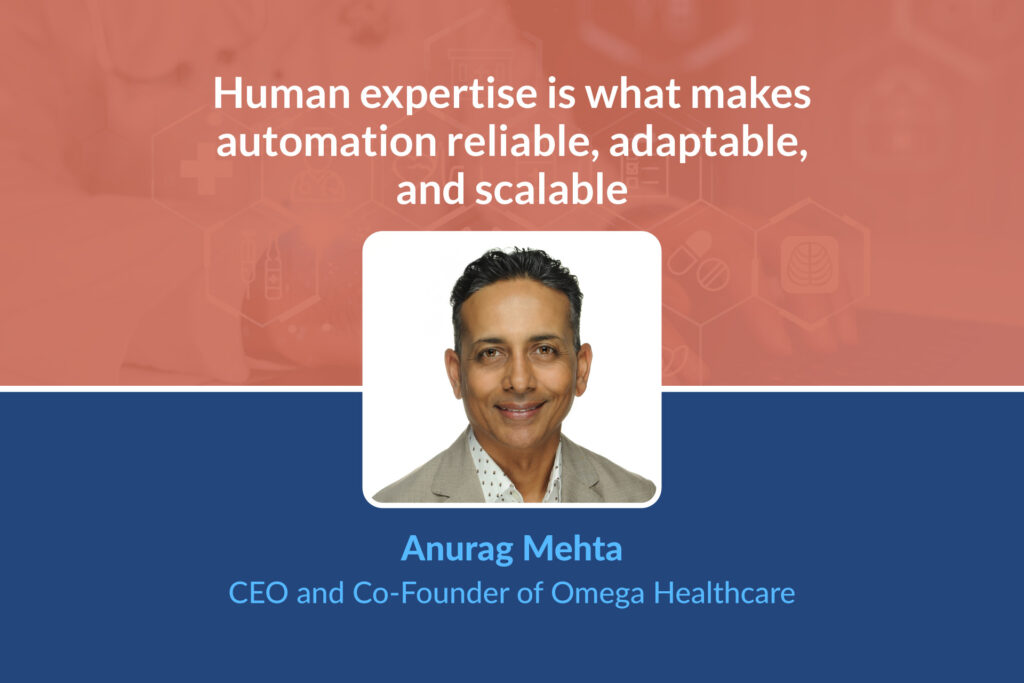
By Anurag Mehta, CEO and Co-Founder of Omega Healthcare.
Healthcare is being reshaped by persistent financial pressures, regulatory changes, and the rapid proliferation of AI. Revenue systems built for a slower, more predictable environment can no longer keep up. As the payer/provider dynamic becomes more complex, denials rise, and administrative burden grows. Therefore, static or fragmented workflows quickly become liabilities.
This constant firefighting forces organizations to have both eyes firmly fixed on the present to stay afloat, preventing them from looking to the future and ensuring their systems adapt. Said another way, both talent and financial resources are allocated to the here and now, versus allocating for building a truly tech-enabled revenue cycle system, and this misallocation risks long-term financial health.
I have worked in revenue cycle management (RCM) for over 25 years now, and I have long believed that technology is essential to success, and this belief has never been stronger. For the first time in the history of our civilization, real intelligence is available on demand and technology has now moved from optional to essential in RCM. Leaders are not adopting AI because it’s novel or cool. They are doing it because, given the way revenue operations are structured, it just cannot keep pace with the constant change to remain efficient.
An Everest Group report supported by Omega Healthcare, captured insights from 41 senior healthcare executives and RCM leaders on AI in RCM. An overwhelming majority (85%) expect AI, generative AI, and agentic AI to improve efficiency over the next five years. More than half are already testing or actively considering AI-driven use cases. This confidence is grounded in real operational exposure, particularly to the upstream breakdowns in eligibility, documentation, and authorization that determine revenue outcomes long before a claim is submitted.
As adoption accelerates, it has become clear that AI is not simply a technological upgrade inside RCM. It is an operating decision. The difference between AI that delivers meaningful improvement and AI that introduces new risks comes down to how intelligence is designed into workflows and how it is shaped by expertise.
AI Alone Can’t Deliver RCM Excellence
RCM is not a predictable, rules-based environment. It operates at the intersection of clinical nuance, payer/provider interpretation, regulatory oversight, and financial accountability. These variables vary by payer, provider, specialty, and patient context, often in ways that don’t lend themselves to simple automation.
That is why many early AI efforts struggle to scale. When intelligence is layered on top of existing workflows, teams are forced to reconcile machine output with real-world exceptions. Accuracy becomes inconsistent, adoption slows, and instead of reducing friction, AI introduces a new set of handoffs and checks.
The Everest Group’s findings closely align with what we see on the ground. Nearly 80% of healthcare leaders point to limited internal AI expertise as a key barrier, compounded by persistent issues with data quality, EHR integration, and regulatory complexity. These are operational realities that technology alone cannot work around.
What works in RCM is not AI replacing human judgment, nor humans simply validating AI outputs after the fact. What works is intelligence shaped by domain expertise from the start, so models reflect clinical reality and compliance requirements as they evolve. That expertise guides how risk is identified, how exceptions are handled, and how systems adapt over time.
What Actually Works in Real-World RCM Environments
Among the 51% of providers surveyed by the Everest Group who are actively exploring generative AI in RCM, whether through proof-of-concept testing or early deployment, gains are definitely emerging. Eligibility verification is becoming more accurate. Claims analysis is helping teams reduce avoidable denials. Documentation support is improving coding quality, while patient-facing interactions are becoming faster and more consistent.
These improvements are most visible when AI supports work earlier in the revenue cycle, where outcomes are shaped before issues cascade downstream. The focus is not on replacing teams or introducing new layers of oversight, but on helping staff get work right sooner, with clearer guidance and fewer corrections later.
This is the philosophy behind how we think about platforms like the Omega Digital Platform ®. Technology for technology’s sake is not the point. The point is embedding intelligence directly into the systems teams already rely on, so guidance arrives in context. Decisions improve earlier, and operations become more effective over time. Human expertise is what makes automation reliable, adaptable, and scalable. Omega Healthcare’s true differentiator is our immense depth of understanding developed over decades across various specialties and care settings, and our mission is to ensure this knowledge is leveraged to develop purpose-built technology that helps our team improve efficiency. At the end of the day, our only true KPI is creating the largest net increase in cash for our customers in the shortest time period, and I truly believe that our tech-enabled solution offers the lowest cost of ownership with the highest yield for customers. Instead of our customers needing to invest in adopting cutting-edge technology, we are committed to continuing our strong record of removing CapEx and drastically reducing OpEx for our customers and their revenue operations.
The Next Phase of RCM
Revenue systems built for static rules and one-time optimization will continue to fall behind. Payer requirements will always keep shifting. Documentation standards will evolve, and regulatory scrutiny will increase. In this environment, revenue operations must be designed to adjust continuously, using real-world signals to guide work earlier in the process and reduce downstream disruption.
This also requires a clear understanding of the role expertise plays alongside AI. As intelligence scales across the revenue cycle, expert teams must help shape how it is trained, governed, and applied. This ensures accuracy, compliance, and accountability as conditions change.
By 2030, AI and machine learning are expected to become the top investment priority for RCM leaders. At the same time, organizations are moving away from transactional approaches toward strategic partnerships that combine technology, operational rigor, and domain expertise to sustain performance as requirements evolve.
In this future state, RCM excellence will be defined by revenue operations that remain accurate and responsive even as complexity increases. Intelligence will need to live inside workflows, not alongside them, and expertise will need to be built into the system itself.
Revenue operations leaders should seek partners, not just vendors, who can bring the combination of human expertise, complemented by AI-powered excellence, to transform and elevate how their RCM can keep pace with an ever-changing environment.